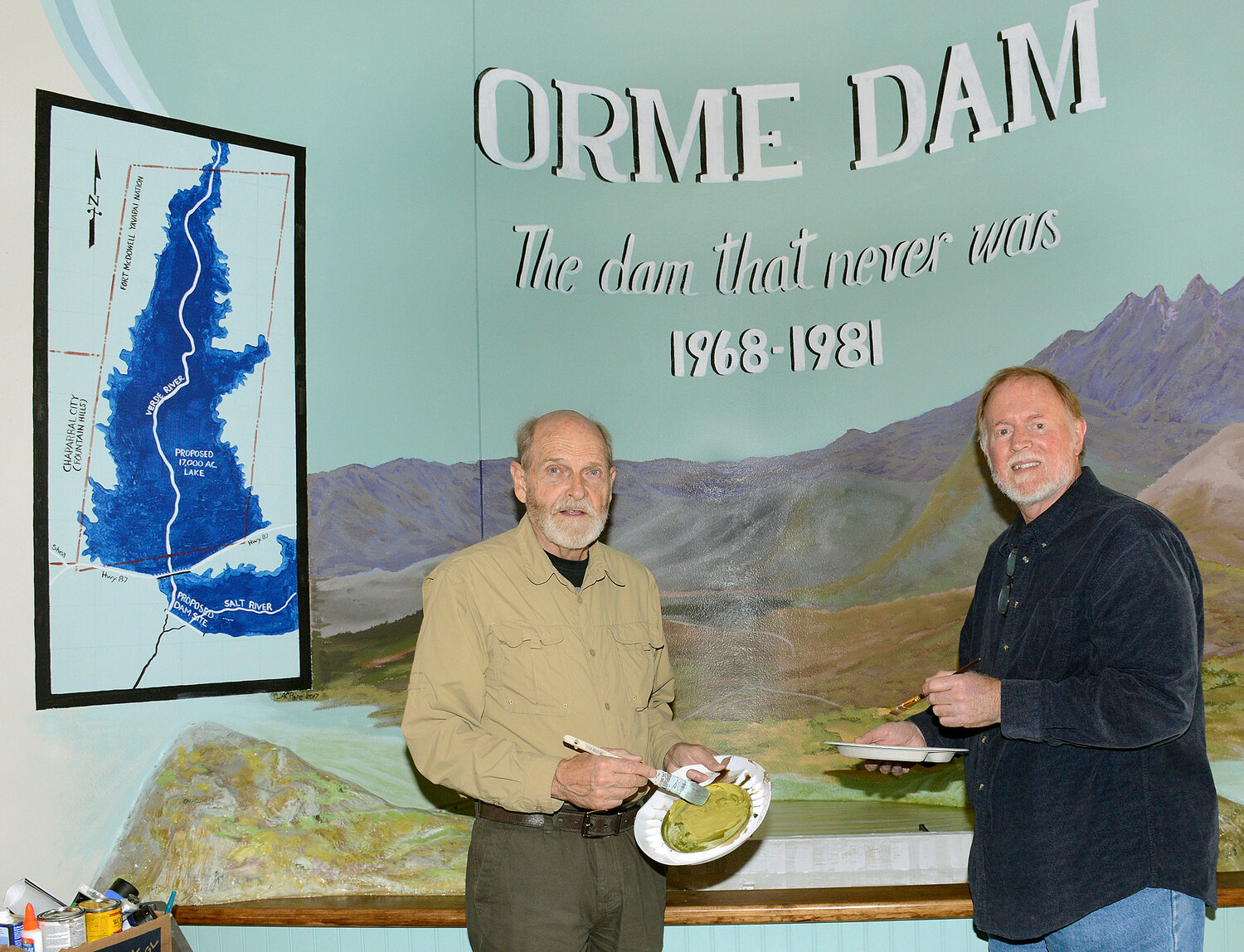
Alan Pape and Mike McWethy work on the new exhibit.
If construction of Orme Dam had not been opposed by the Fort McDowell Yavapai Nation, Fountain Hills most likely would not exist.
River of Time Museum’s artist-in-residence Alan C. Pape explained the importance of the newest exhibit, “The dam that never was.”
Pape, a seasonal visitor from Wisconsin, estimates he devoted about 70 hours to design and paint the 65-foot mural. Mike McWethy, a member of the Fountain Hills Woodworkers Club and a colleague, installed the wood base over five days.
You must be a member to read this story.
Join our family of readers starting at $5 for your first month and support local, unbiased journalism.
Click here to see your options for becoming a subscriber.
Register to comment
Click here create a free account for posting comments.
Note that free accounts do not include access to premium content on this site.
I am anchor
Museum features 'the dam that wasn't' exhibit
Alan Pape and Mike McWethy work on the new exhibit.
Posted
If construction of Orme Dam had not been opposed by the Fort McDowell Yavapai Nation, Fountain Hills most likely would not exist.
River of Time Museum’s artist-in-residence Alan C. Pape explained the importance of the newest exhibit, “The dam that never was.”
Pape, a seasonal visitor from Wisconsin, estimates he devoted about 70 hours to design and paint the 65-foot mural. Mike McWethy, a member of the Fountain Hills Woodworkers Club and a colleague, installed the wood base over five days.
Pape consulted Albert Nelson, Yavapai cultural director, for content accuracy.
“This is really their (Yavapai) story,” said Pape. “I want visitors to know that three-fourths of their land was going to be flooded without them knowing.
“Back in the late ‘60s, almost every state in the United States had a federal dam project to dam up rivers to make electricity. The Bureau of Reclamation got really good at the engineering part but not the human part.”
The proposed Orme Day at the confluence of the Verde and Salt Rivers would have flooded Yavapai nation, its sacred sites, farmland and access to the river.
“They (the federal government) were going to offer 2,500 acres farther in the mountains where the soil was terrible. No river or water access. They were going to give them $33 million. A few said OK but the majority said no,” said Pape.
Opponents rallied the support of fellow tribal members, other Native American tribes and non-Indian groups to march three days, 30 miles to the state Capitol in Phoenix.
On Nov. 12, 1981, after consulting with Fort McDowell Tribal Council and the Governor’s Advisory Committee, Interior Secretary James Watt announced that Orme Dam would not be built. Each year a tribal fair and rodeo is held to commemorate the event.
Pape’s historical background involves membership in the Wisconsin Historical Society for many years.
In the last three years, Pape said he focused on creating exhibits to tell stories. He and McWethy built a model diorama of the original Fort McDowell during the Civil War and Pape created the ranching display.
Pape also wanted to tell the Orme Dam story for a second reason.
“We would not be sitting here in this museum if the Orme Dam wasn’t proposed,” said Pape.
McCulloch Properties, Inc., a California developer, acquired 12,000 acres with plans to build a city with waterfront properties created by the dam.
Once the dam was scratched, McCullough returned to the drawing board for a new concept.
“It was the first federal dam project to be stopped in America,” said Pape, although it took 13 years.



Comments
No comments on this item Please log in to comment by clicking here